
6 Types of Andersen Replacement Windows (And How to Pick the Right One)
It's January in Indiana, and you love a good snowstorm. That is...you love a good snowstorm when you are inside, seated on your favorite recliner, looking out the window. But unfortunately, cold air is sliding off the glass that is giving you this beautiful view. And, no matter where you set the thermostat, the room still feels drafty.
Fortunately for you, Andersen replacement windows fix all of that. But then comes the next hurdle. You start shopping and run into words like casement, awning, and gliding, plus a list of series numbers that mean nothing to anyone outside the building industry.
At Graber Supply, we have supplied home building products to north central Indiana families for over 35 years, and we are a certified Andersen dealer. We love helping homeowners simplify the choices they have to make.
Here is a plain explanation of the six styles we carry, what those series numbers mean, and four things to check before you order.
TL;DR - 6 Types of Andersen Replacement Windows (And How to Pick the Right One)
No time to read? Here’s the short version.
- Six styles to pick from: double-hung and single-hung, casement, awning, gliding, bay and bow, and pass-through.
- Match the style to the room. Casement above the kitchen sink, awning where you want privacy, gliding next to a deck or walkway.
- Five Andersen series. 100 and 200 for value, 400 for proven performance, A-Series for top efficiency, E-Series for the most customization.
- Check the energy label. Our part of Indiana is in the ENERGY STAR Northern climate zone, so look for a U-factor of 0.22 or lower.
- An odd-sized opening is not a problem. Andersen offers custom sizing in eighth-inch increments.
- The warranty transfers to the next owner, so the value stays with your home if you sell.
6 Types of Andersen Replacement Windows and Where Each One Works Best
There are six main styles of Andersen replacement windows, and each one earns its spot in a different part of the house. Once you know what each does, the right choice usually becomes obvious.
1. Double-Hung and Single-Hung Windows
These are the windows most people picture when they hear the word "window." Sashes slide up and down inside the frame. On a double-hung, both sashes move, and both tilt inward, so you can wash the outside glass from inside your living room. That matters on a second story. On a single-hung, only the bottom sash opens, which usually makes it the cheaper option.
Hung windows are the most common style in Indiana homes, and they usually drop right into an existing opening. Andersen offers double-hung across every series and single-hung in the 100 Series.
2. Casement Windows
Casement windows are hinged on the side and crank open to the left or right. The whole sash swings out, so you get airflow from top to bottom. They also seal tightly when closed, which makes them one of the better styles for stopping drafts.

You will most often find these above a kitchen sink, where reaching across the counter to lift a sash is a pain. Andersen recommends keeping them away from walkways and porches where someone could walk into an open window.
3. Awning Windows
Awning windows are hinged at the top and open outward from the bottom. The open sash acts like a small roof, so you can leave one cracked during a light rain and stay dry inside.
They work well set high on a wall in a bathroom or bedroom where you want fresh air and privacy at once. Many homeowners pair them under a large fixed window to get both a view and ventilation.
4. Gliding Windows
Gliding windows, sometimes called sliding windows, open side to side along a track. Nothing swings outward, which makes them a smart fit next to a deck, patio, or sidewalk. You still get airflow from top to bottom without anything sticking out into the walkway.
5. Bay and Bow Windows
Bay and bow windows combine three or more windows that angle out past the wall of your home. You get more natural light, a wider view, and an interior shelf where the window projects out. That shelf, called a seat board, often becomes a window seat or a spot for plants.
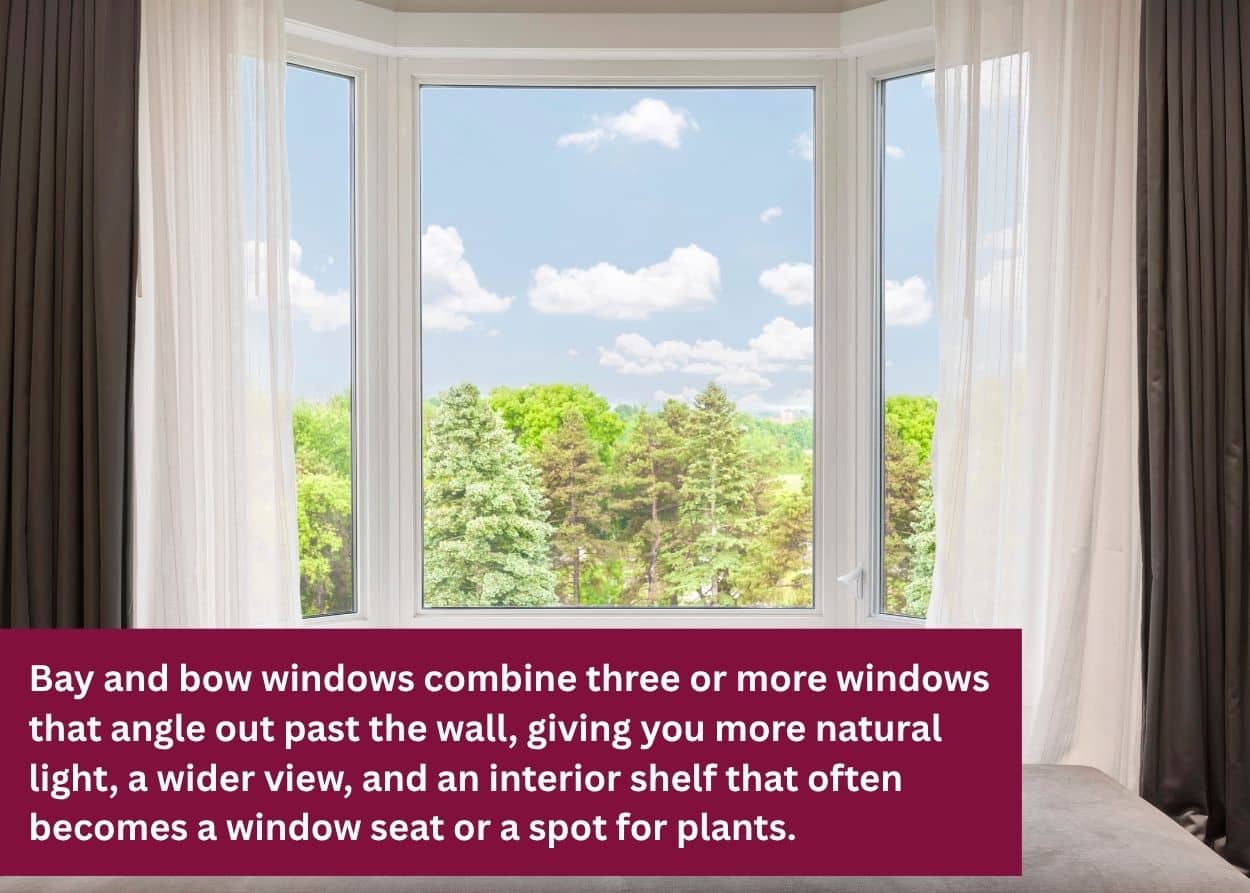
A bay usually has three windows set at an angle, while a bow uses four or more in a gentle curve. Andersen offers both with either casement or double-hung sashes.
6. Pass-Through Windows
A pass-through window is a large opening built for homes without room for a patio or deck door. It lets in light and air, and it is big enough to hand plates and drinks out to the porch. If you cook and entertain outside, this one is worth a look.
Not sure where to start? Here is the short version:
- Above the kitchen sink: casement
- Bathroom or bedroom where you want privacy: awning
- Next to a deck, patio, or walkway: gliding
- Second-story bedrooms: double-hung
- Living room feature wall: bay or bow
- Serving food outdoors: pass-through
We go deeper on matching style to layout in our post on choosing the perfect windows for your home.
5 Andersen Window Series, Explained in Plain English
Once you pick a style, the next question is which series to order. Andersen groups its windows into five lines, and the differences come down to materials, color choices, and price.
- 100 Series. Built with Andersen's Fibrex composite, which is stronger than vinyl and needs very little upkeep. The budget-friendly line.
- 200 Series. Wood inside, protective vinyl outside. A step up in looks without a big jump in cost.
- 400 Series. The most popular line, and the one our customers mention most in their reviews. Wood interior, low-maintenance exterior, long track record.
- A-Series. Andersen's top architectural line, with the best efficiency options and the widest range of colors and interior woods.
- E-Series. The most customizable line, with nearly any color you can name.
One thing applies to all five. Every Andersen window carries a limited warranty that transfers to the next owner if you sell, so the value stays with the home. The details are on Andersen's warranty page.
We will also be straight with you. Andersen costs more than some other brands. We think the quality justifies it, but you should hear both sides, which is why we wrote up the honest pros and cons of Andersen windows.
4 Things to Check Before You Order Your Windows
Before you sign off on a quote, think through each of these four items.
- How you use the room. Think about airflow, how you will clean the glass, and what sits outside the window. A casement over a busy walkway is a problem you only notice after installation.
- The numbers on the energy label. Two ratings matter most. U-factor measures how much heat escapes, and lower is better. Solar heat gain coefficient measures how much of the sun's heat comes through the glass. Our part of Indiana sits in the ENERGY STAR Northern climate zone, so a low U-factor is the priority. Look for 0.22 or lower. ENERGY STAR reports that swapping single-pane windows for certified ones lowers energy bills nationwide by up to 13 percent on average. Ask us about Low-E and triple-pane glass.
- Your budget, honestly. ENERGY STAR estimates installed replacement windows start around $400 each and climb past $1,600 for premium options. That range is wide because every project is different, which is why we quote each home individually instead of posting a price list.
- Fit. Older homes often do not have standard-sized openings, and that is fine. Andersen offers standard sizes plus custom sizing in eighth-inch increments. We can come measure for you (a fee may apply), or you can measure yourself using Andersen's guide.

How We Make Getting Andersen Replacement Windows Simple
Here is what working with us looks like from start to finish.
- Contact us. Stop by our showroom in Amboy or schedule a consultation.
- Review your quote. We send a customized quote to look over, with no pressure.
- Install. Use our team or bring in a contractor you already trust.
- Enjoy. Live with windows that work the way they should.
We serve homeowners across Miami, Cass, Grant, Howard, and Wabash counties, including Marion, Peru, and Kokomo. See our full lineup on our Andersen windows and doors page.
Your Home Can Feel Comfortable Again
Picture next January. You are in that same chair by the window with a cup of coffee. But this time, the cold air that is swirling the snow outside is staying outside, and the draft that was chilling the edges of your room is gone. The house is warmer and quieter, and best of all, the heating bill is less than last year.
You do not have to become a window expert for this to be your reality. You just need someone local who knows the products and will tell you the truth about them.
Get a quote on your Andersen replacement windows, or stop by the showroom and see them in person. You can also contact us at 765-395-7715.